From Smart Materials to Earth’s Thermal Mass: Two Paths to Cooler, Greener Homes
2026-01-19
Earth renders – a story of sand, earth, clay and poo
2026-02-02
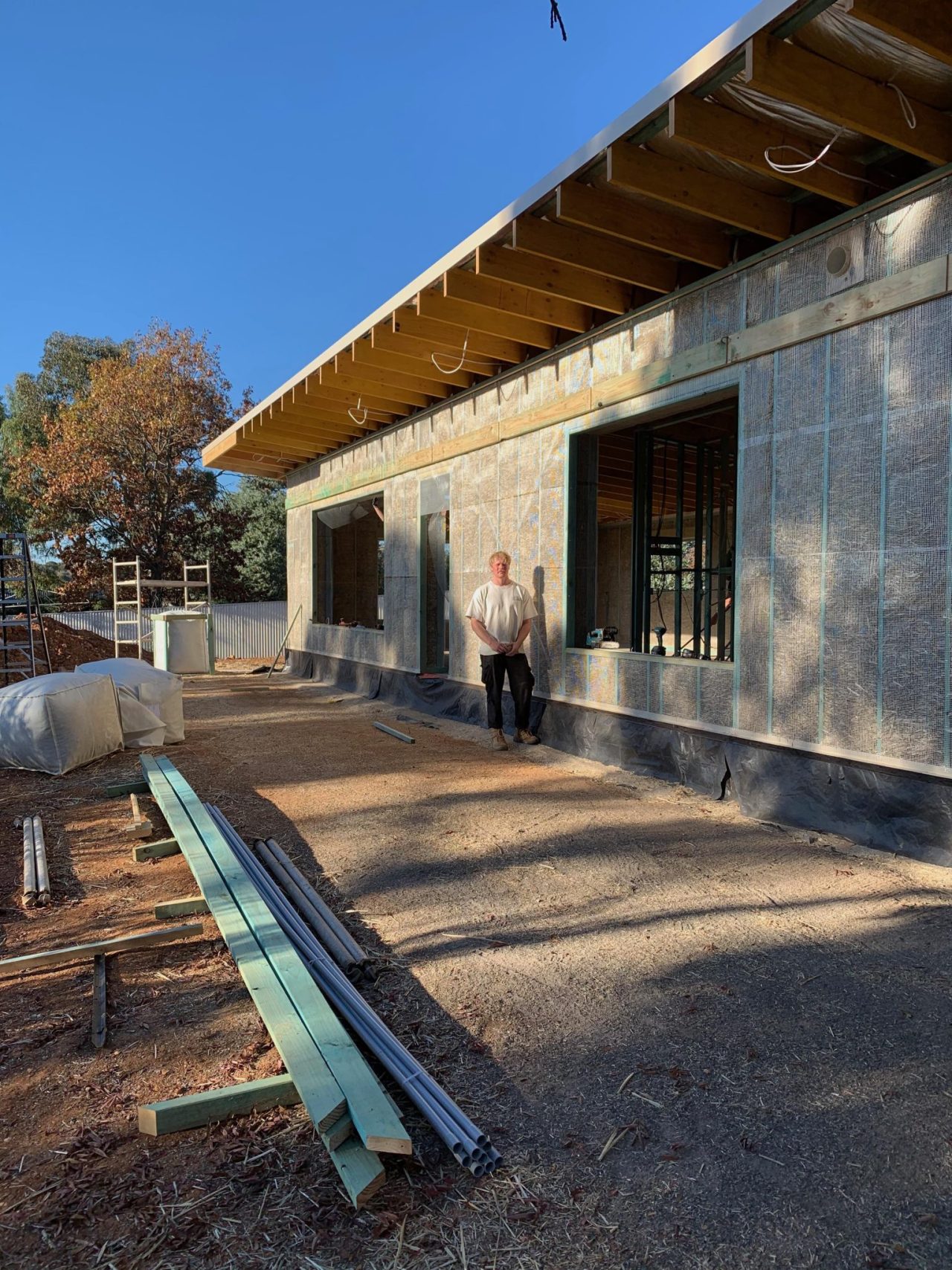
As Australia continues to face increasingly severe bushfire seasons, interest in natural building materials like strawbale, hemp‑lime, and cob has surged.
These materials have long been stereotyped as “flammable,” but modern testing and on‑the‑ground performance tell a far more nuanced—and encouraging—story.
This blog explores the current state of fire‑resistant natural construction in Australia, why some traditional assumptions are outdated, and how clever design can dramatically reduce ember attack vulnerabilities. It also includes direct links to the Green Rebuild Toolkit, an essential resource for resilient rebuilding.
Strawbale Construction: Fire Ratings & Misconceptions
Despite the persistent myth that straw equals fire risk, rendered strawbale walls are highly fire resistant.
What the tests show
- Rendered strawbale walls achieve a fire rating of FRL 90/90/90 (1.5 hours) according to internationally certified results accredited for Australia.
- When constructed to specification, strawbale can comply with BAL 12.5 through to BAL FZ bushfire zones under AS 3959.
- CSIRO testing previously concluded that rendered strawbales are suitable for BAL‑29 bushfire zones, although newer test regimes require updated assessments for the highest‑risk areas.
Why strawbale resists fire
Once rendered, strawbale becomes “like trying to burn a telephone book”—dense, oxygen‑starved, and encased. Compression removes air pockets, and the plaster skins (lime, clay, or cement‑based) provide a protective non‑combustible layer.
Why Lime Render Improves Fire Safety
Lime renders outperform cement in fire scenarios because they are:
- Non‑combustible and resistant to high temperatures.
- Breathable, reducing trapped moisture that can weaken walls.
- Compatible with natural fibres like straw and hemp.
Recent testing of hemp‑lime rendered systems in Australia confirms lime‑based renders’ performance at the highest bushfire levels:
- A 200mm hempcrete wall with a 10mm hemp‑lime render achieved BAL‑FZ compliance, with no temperature rise on the unexposed face in AS 1530.4 testing.
- Hemp‑lime systems routinely achieve Group 1 fire ratings, the highest classification for internal linings.
Lime’s mineral composition makes it inherently fire‑resistant, and its permeability helps maintain the integrity of natural walls over time.
Clever Design Against Ember Attack
Embers are responsible for the majority of homes lost in Australian bushfires. Good design—in both conventional and natural buildings—focuses on closing gaps, protecting openings, and managing landscaping.
Key proven strategies include:
- Ember‑proofing the building envelope
- Use metal mesh on all vents, windows, and doors.
- Seal gaps under eaves and decks to prevent ember entry.
- Choose double‑glazed or toughened glass to resist radiant heat and breakage.
- Fire‑smart landscaping (defensible space)
- Maintain a 30‑metre fuel‑reduced zone around the home.
- Use fire‑retardant species (succulents, deciduous trees) and avoid flammable mulches near the structure.
- Break up plantings to prevent flame pathways.
- Choosing the right materials
Natural materials like cob, light straw‑clay, and hemp‑lime all show strong fire resistance due to their earthen or lime‑based binders:
- Cob has achieved two‑hour fire‑resistance ratings in ASTM E119 tests.
- Light‑straw clay and hemp‑lime rely on their plaster skins for fire protection, creating a solid and stable barrier.
Natural Materials in Australia: The 2025–26 Landscape
Australia’s shift towards sustainable, low‑carbon, fire‑resistant materials is accelerating:
- Hempcrete is now recognised as inherently fire resistant and compliant up to BAL‑40 with 200–300mm thickness and lime render.
- Natural materials like straw, clay, and hemp sequester carbon and support Australia’s sustainability goals, especially as NCC 2025 introduces more stringent, accredited fire testing requirements.
Good Design for Fire‑Prone Regions: Beyond Materials
While fire‑resistant materials like strawbale, cob, and hemp‑lime form a solid foundation, designremains the most critical factor in whether a building survives a bushfire. Australian evidence and post‑fire assessments consistently show that ember entry, radiant heat exposure, and landscaping decisions have more impact on survival than the choice of wall system alone.
-
The Fundamentals of Bushfire‑Resilient Design
Key recommendations for Australian homes include:
- Closing ember pathways:
Bushfire‑resistant homes rely on metal mesh screens at vents, windows, and doors, plus careful sealing of gaps under roofs, eaves, and decks. These are among the simplest and most effective lines of defence. - Upgrading glazing:
Tempered or double‑glazed glass significantly reduces breakage under extreme heat and limits the likelihood of ember intrusion. [leadesign.com.au] - Creating defensible space:
A 30‑metre low‑fuel zone around the house—using moisture‑rich plants, wide gravel paths, and separation between shrubs—drastically reduces flame contact and radiant heat.
These measures complement natural materials’ fire‑resistant properties and are essential regardless of construction system.
-
Are Fire Bunkers Worth It?
Fire bunkers have become an area of public interest since the 2009 Black Saturday fires, but their effectiveness depends entirely on design, certification, and context.
While the sources above do not provide bunker‑specific evidence, bushfire‑resistant design guidance emphasises that defending in place is rarely recommended unless protection systems and the building envelope meet stringent fire performance levels. Given that even BAL‑rated structures experience extreme conditions—direct flame contact at BAL‑FZ and heavy ember attack at lower BAL levels—most official rebuilding resources (such as the Green Rebuild Toolkit) focus instead on safer design, evacuation planning, defensible space, and material choices, not on bunkers as a default solution.
Many architects and fire engineers caution that:
- Bunkers must be tested and accredited to withstand oxygen depletion, radiant heat, and structural load.
- Improvised or non‑certified bunkers can create fatal entrapment risks.
- A bunker should be considered a last‑resort refuge—not a primary bushfire strategy.
Given the emphasis in current Australian design guidance on safer building envelopes and early evacuation, bunkers should only be considered where professionally designed and certified, and integrated into a broader, well‑thought‑out fire plan.
-
Earth‑Covered and Earth‑Integrated Homes
Earth‑covered or partially earth‑sheltered homes are increasingly discussed as a bushfire‑resilient option because soil is a natural fire barrier. While our current search results did not surface Australian‑specific performance data on earth‑covered homes, the broader evidence on non‑combustible, high‑mass materials (such as cob and hemp‑lime) in fire contexts is clear:
- Cob walls provide up to two hours of fire‑resistance under ASTM E119 testing.
- Lime‑rendered natural wall systems (strawbale, hemp‑lime, light straw‑clay) form solid, fire‑resistant barriers that withstand prolonged radiant heat.
Earth‑covered homes can benefit from:
- Reduced exposure of external walls to embers
- Minimal flammable cladding
- Stable indoor temperatures, reducing vulnerability during extreme heat events
However, they come with design complexities:
- Moisture management and drainage are critical.
- Roof loading, structural engineering, and egress requirements must meet code.
- BAL‑specific compliance still applies to exposed elements (openings, roofs, entrances).
Given Australia’s strong movement toward low‑carbon, high‑mass, fire‑resistant materials and the 2025 shift to more stringent, accredited fire‑testing requirements in the NCC, earth‑integrated concepts may become more mainstream in future bushfire‑resilient architecture.
-
Putting It All Together: A Multi‑Layered Defence
A well‑designed home in a fire‑prone region uses layered resilience:
Material Level
- Lime‑rendered strawbale, hemp‑lime, cob
(all tested and proven fire‑resistant in Australian and international contexts)
[naturalbui…tralia.org]
Design Level
Landscape Level
Planning Level
- Early evacuation strategy
- Optional certified bunker only as a last resort
This integrated approach—rather than reliance on any single element—aligns with current Australian fire‑resilience research and rebuilding recommendations.
Essential Resource: The Green Rebuild Toolkit
For Australians rebuilding after bushfires—or designing for resilience—the Green Rebuild Toolkit is one of the most comprehensive resources available.
What it offers
- Step‑by‑step guidance on climate‑ and bushfire‑resilient design
- Materials & construction advice (including bushfire‑resistant materials)
- Case studies of resilient homes
- Webinars and expert talks on bushfire‑aware design
Access it here:
👉 Green Rebuild Toolkit – Renew: https://greenrebuildtoolkit.com/
- Light House Architecture & Science summary of the toolkit’s features.
You can also catch up the whole webinar series delivered in 2023 where we talked to the experts on good design and materials for fire-prone regions (and let’s face it, there’s a lot more of them now than there were). Green Rebuild Toolkit — Event Recordings – YouTube
Conclusion
The evidence is clear: natural materials can be among the safest, most fire‑resistant options available in Australia—if designed and built properly. Strawbale, hemp‑lime, cob, and other natural systems pair fire‑resistant chemistry with sustainability and thermal performance, offering a compelling alternative to conventional construction.
As bushfire risk intensifies, embracing these materials—supported by accredited testing and smart design—helps create homes that are not just greener, but genuinely safer.